
Solitude is a mirror
revealing faces
some forgotten
others never were
stories I've told

Solitude is a stage
many actors
playing roles they are not
complete credibility
to applause and laughter

Solitude is a blank wall
seeing self
thoughts passing by
images come and go
until the bell rings

Solitude is time
dawn to dusk
sleep and dream
early morning coffee
evening stillness

Solitude is a womb
living being
gathers strength to emerge
learns to breathe
stand alone.
-
-
streams of change
come together
during this quiet time

may all beings be at ease

they follow the way
unknown to them
carrying leaves along

may all beings be at ease

I am carried with them
every eddy and pool
no sense struggling

may all beings be at ease -
the hermit poets of Japan and China
satisfy a Zen aspiration in me
I cannot live so simply or remote
I am not an old monastery monk
never held whisk or stick
what we share is Zen

of the sutras they are silent
monastery and rules left behind
living on mountains in huts they made
farming foraging to make their way
watching clouds pass streams flow
sitting cross-legged on rocks

I sit with a cup of coffee a glass of wine
tapping away on electronic devices
all my needs well supplied
I could not be further from them
in space time culture
yet they draw me into their world

in common they stepped away
saw the Buddha within the Way clear
- seeking enlightenment a waste -
it was what they already possessed
to live what books or teachings
overlay with obscurity and mystification

their writings reveal Zen life
beyond talk theory philosophy speculation
beyond koans abstruse sutra logics
beyond Bodhidharma Dogen Lin-chi
realizing the Way they stopped searching
settled down with the mountains and clouds -
it is a line that came to me
several writings ago -
solitude, caretaker of soul.
The more I live with solitude
experiencing it's healing touch
the more I believe it true.

Not everyone gets this time
long enough time
to see the fruits.
I have this time now
choosing more, more
than I imaged when I stepped away.

Calm has come to me
I wish it to remain
when I reenter the world.
It is not so long
these six months
considering the long life
behind me
not knowing how long
ahead.

I will enter summer
in solitude
long warm days and nights.
At summer's end
with family for a time -
Manzanita dunes and tides
to remember with them
their mother grandmother.

Six months end in October
sesshin at Upaya, Sante Fe.
It will be well to finish solitude
one week in silence sitting. -
this is home now
cold spring skies
woodpecker in the pine
marine layer mornings
all the lovely evenings.

Years working downtown
my cubicle window
watching ferries
cross the Salish sea,
water mountains sky.

No way to remember
all our memories here -
Carol and Tom.
Friends we knew are here still
with whom we shared life.
They remember her well
remain good to me.

I have new friends now,
for a time stepping away
not for loving them less
caring for her memory more.

Alone, I drink wine on my veranda
remembering evenings.
We shared these moments
through the seasons.
Planning life now
I have no one like her to talk to
over a nice glass of wine
or other of the
libations that life offers.
Perhaps I need a spiritual director
or a wise zen teacher?
No. Those won't do.
No one can replace a love
sitting side by side
through the days and nights
together.
-
The self, "my self," takes pleasure
in this lovely spring evening.
__________________________________

My study of self consciously began
the day I stepped away from sangha
beginning a long overdue soul-searching
following my wife's death.

My time away is much needed
evidenced by things I've discovered
I might not have otherwise.
This is no straight path
but one of trial and error.

Recently I began a list of my thinking habits
that "need careful study."
My list, however accurate or complete,
       (never accurate or complete)
is not helpful.
I trust Master Dogen
did not mean for us to begin self-study lists
checking items off on completion.
In Fukanzazengi, due to the intimate nature of zazen,
Dogen clarifies things advising,
"...take the backward step... illuminate the self."

What might the light of zazen reveal?
All my faults failures fears fantasies?
Those I can see by any ordinary light!
The light that illumines self
must be able to penetrate to the deep dark
where it is most needed.

There is no gaining mind in zazen
not because I tell myself to expect nothing
but because, even were I to try,
my thinking mind would be denied access
to the sublime sinuous pathways
of my ancient and twisted karma.
There's the rub - the dark of shadowy hidden regions
my thinking mind could not begin to comprehend.

Zazen provides a sanctuary
where only the enlightened mind can go -
probing deep, sending deft fingers to places
hurt unhealed scared and scarred,
resting in those places for a time
taking them silently away when the bell sounds. -
To study the Buddha Way is to study the self.
To study the self is to forget the self.
To forget the self is to be:

          *actualized by myriad things
          *confirmed by all dharmas
          *enlightened by the myriad dharmas
          *experienced by millions of things and phenomena
          *authenticated by the myriad things
          *enlightened by all things
          *verified by all things
          *perceive oneself as all things
                 (thezensite.com)
Translation is a tricky business
certainly when translating Dogen.
Eight translations of an essential point -
what it is to forget the self.
Do these all mean the same thing?
Do any accurately translate Dogen's intention?
I think we get to take our pick
the one that speaks to our heart.
For me, I go with the clunkiest one:
"...EXPERIENCED BY millions of things and phenomena."
The rest seem to leave self in place
as the actor whose studies
have accomplished the thing.
But to be experienced BY all things and phenomena
seems to me to be quite a different thing.
To believe that all things cooperate
in the experience of a sense life
that communicates with us
is profound beyond measure
but no more profound
than our Bodhisattva vows.
My inspiration comes from Annie Dillard:
"Then one day I was walking along Tinker Creek thinking of nothing at all and I saw the tree with the lights in it. I saw the backyard cedar where the mourning doves roost charged and transfigured, each cell buzzing with flame. I stood on the grass with the lights in it, grass that was wholly fire, utterly focused and utterly dreamed. It was less like seeing than like being for the first time seen, knocked breathless by a powerful glance."
I'll keep studying but while I do I'll remember Annie Dillard's experience and words, ones that have stayed with me for fifty years, since I first read and was stunned by her magnificent work, Pilgrim at Tinker Creek.
She gets the final word here:
"...I had been my whole life a bell and never knew it until at that moment I was lifted and struck."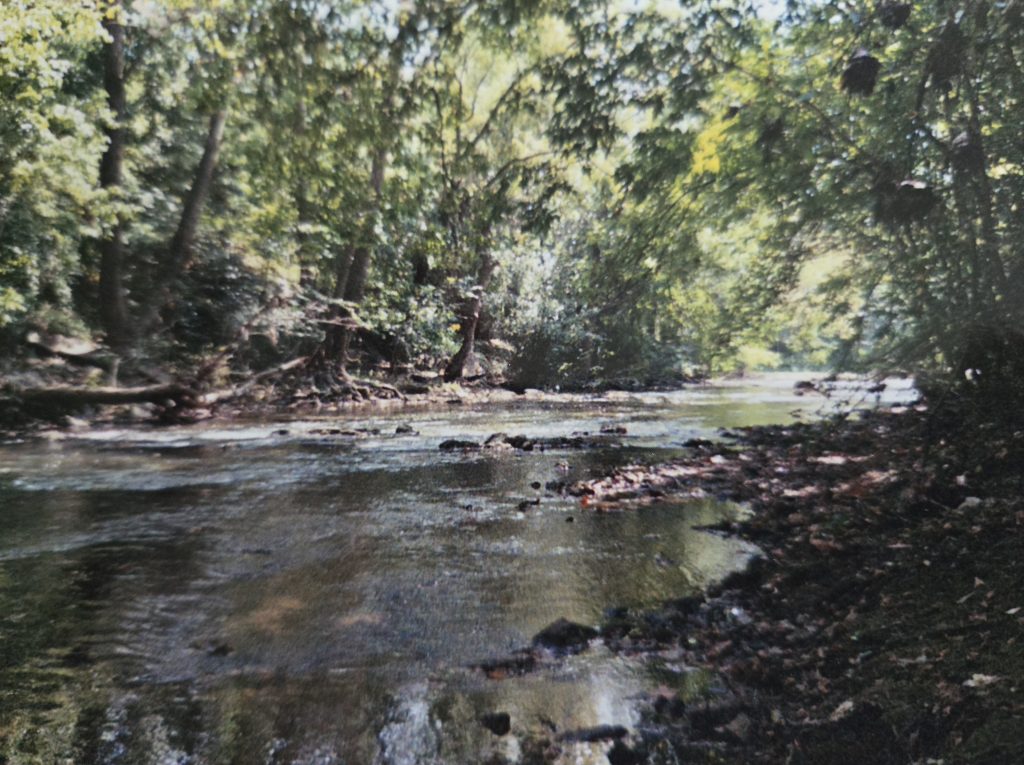
My photo of Tinker Creek, near Roanoke, Virginia.
-
Studying self is a troubling task
bringing to mind what seems better to ignore
having ignored for so long
habits of self and mind etched as grooves
in a long-playing record
whose familiar and discouraging tunes
won't stop playing.

While walking a lovely park
under tall trees beside a brilliant shine of water
where my train of thoughts seemed out of place
dwelling as they were on habits and energies
that have long defeated my better nature
I allowed my reflections and sensations to arise
recognizing them as they came.

Recognition. Could Dogen's "study" be so simple?
To recognize. Allow what is to be seen and
without attempting to deny or ignore
forgive with a divine absolution?
For my ways began as impulses to help me along
born when I was very young
when as yet I had no way to understand. -
"To study the Buddha Way is to study the self.
To study the self is to forget the self.
To forget the self is to be verified by all things."
Eihei Dogen - Genjo Koan
My time away is study of self.
More than seven years
since Carol diagnosed with cancer.
Four years in treatment
her death.

Nine months until I left Portland.
Seattle - one, two, three, four "homes."
This, the brief version of my storm
only now beginning to calm.
More than seven years.
In calm my study of self begins.

I thought, a month,
I'll need at least a month.
Two months and counting
beginning to grasp
I need and want more time
how much I do not know.
How long does the study of self take?
It never ends.

My time of self study is zazen.
The wall I gaze at is inside.
I have been "the wall" all along. -
Comparing days is futile
one day better than another
when eyes feast on them all?
A spring evening such as this
when clear sky opens to setting sun
breeze lifting lowering branches
is pleasure beyond compare.
I do compare, sad mortal am I.

To see such lights and eve as this
think summer heat and winter chill the less?
Yet! Sensual autumn birthed by summer
falling golden leaves of spring
ancestors of a thousand seasons past
as I, ancestor of a thousand moons.
So it is that I am a spring sweet evening
soon a sailing autumn leaf.
 Living Zen Life